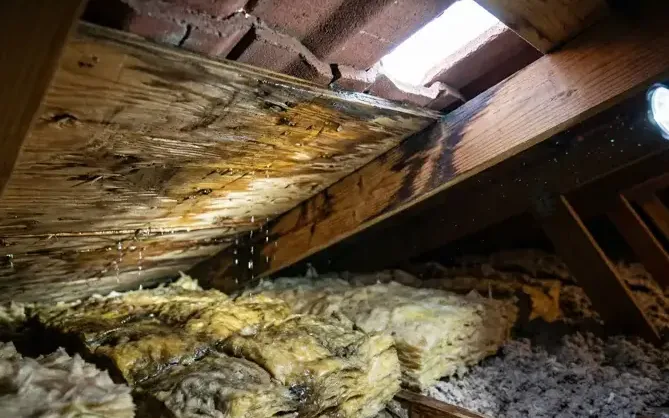
Most of Alpine's rain falls between November and March, and that is when roofs show their weak spots. A stain on a ceiling is the last stage of a leak that started above it.
Key takeaways
- Rain here averages 16.05 inches a year, mostly from November to March, so roof leaks tend to appear in winter.
- In the NOAA 1991 to 2020 normals, February is the wettest month at 3.65 inches, and January follows at 3.21 inches.
- A leak made during the dry summer months often goes unnoticed until the first real storm.
- A ceiling stain sits below the leak, not under the damaged spot on the roof, because water runs along rafters and insulation.
- Wet attic insulation and soft drywall are removed, and sound materials are dried until moisture readings match a dry reference.
When Alpine roofs get tested
The area has a warm-summer Mediterranean climate, with warm dry summers and cool winters that bring moderate precipitation.
Temperatures here are more extreme than in coastal San Diego, with January days in the low 60s and nights in the low 40s.
Rainfall averages 16.05 inches a year, falling mostly from November to March. In the NOAA 1991 to 2020 normals, February is the wettest month at 3.65 inches, followed by January at 3.21 inches.
Measurable precipitation falls on about 42.7 days a year, so a roof gets repeated wetting through the winter rather than one big soak. Summers are very dry, with June, July and August averaging 0.13, 0.10 and 0.12 inches.
- Wettest month: February, at 3.65 inches
- Second wettest: January, at 3.21 inches
- Days with measurable precipitation: about 42.7 a year
- Driest months: June, July and August
Why a summer leak shows up in winter
Roof damage rarely announces itself in a dry month. A cracked sealant, a lifted flashing or a loose vent boot has nothing to leak until water arrives.
Rainfall in Alpine can vary greatly from month to month and from year to year, and the area has numerous microclimates. A roof that stayed tight through a mild winter can leak after a heavier one.
The first storm after a long dry spell is when leaks that formed during the dry months finally show up.
By then the damage may have been building for months. Damp sheathing, framing and insulation wear down over time even when the ceiling below still looks fine.
Reading a ceiling stain
A stain tells where water landed, not where it entered. Water follows rafters, runs along the top of the drywall and drops where the ceiling dips.
Not every stain is a roof leak. A bathroom above, a supply pipe or an air handler in the attic can leave the same mark, so the source is traced before any drywall is cut.
What the shape of the stain says
The shape and edge of a stain give clues about how long the leak has been active.
- A ring with a darker edge often means repeated wetting and drying over several storms
- A bubble or sag means the drywall is holding water and may need to be opened
- A stain that stays damp days after the rain stopped points to wet insulation above it
Checks from the attic
With a flashlight, the underside of the roof deck, the nails and the insulation can show dark stains, water trails or flattened insulation. Wet insulation is heavy and often smells musty.
A homeowner should not walk on a wet or steep roof. Roof repair belongs to a roofer, and the water already inside the house belongs to the restoration crew.
What gets removed and what gets dried
Wet attic insulation loses its value and holds water against the ceiling, so it is usually removed. Drywall that sags or crumbles is cut out, while firm drywall may be dried in place if readings fall in range.
Texture and paint hide the true extent of the wet area. Readings taken through the surface show what the eye cannot, and sections that read high are opened first.
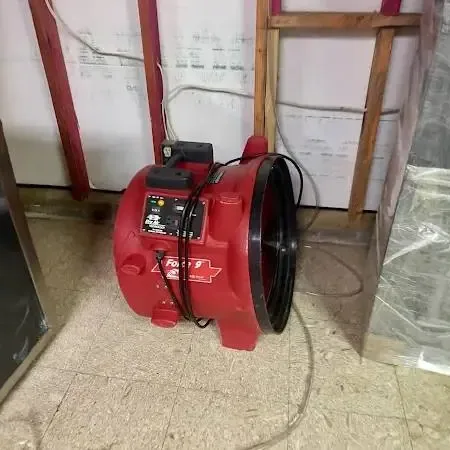
After removal, air movers and dehumidifiers dry the joist bays and the remaining drywall. Moisture readings decide when drying stops.
Roof leak water damage and ceiling leak water damage work follows these steps.
- Insulation that is soaked or compressed
- Drywall that sags, bubbles or crumbles
- Painted ceiling surfaces that peel
- Light fixtures and fans under a wet spot, which need power off and a check
How the repair usually runs
A leak repair follows a fixed order, and skipping a step often means the stain returns.
- The roofer stops the water entering at the roof
- Wet insulation is removed from the attic
- Soft or sagging drywall is cut out
- Air movers and dehumidifiers dry the joist bays and the remaining ceiling
- Final readings confirm the materials are dry
- Drywall, texture and paint are replaced last
Steps to take while it is raining
A leak during a storm calls for quick, safe moves. Temporary roof covers are a job for a roofer, and nobody should climb a wet roof.
Small drips matter too. A slow leak that only appears in heavy rain still soaks insulation and drywall each time, and the damage adds up.
- Place a bucket under a drip and move furniture and electronics out from under the stain
- Turn off ceiling lights and fans under a wet spot
- Photograph the stain with the date visible
- Keep children and pets out of the room if the ceiling sags
- Write down when the rain started and when the stain first appeared
Records and next steps
A dated photo after each storm shows whether a stain is growing, and that record helps both the roofer and the insurer.
Photos of the stain, the attic and the removed materials support a claim. The roofer's invoice, the drying readings and the dates complete the file.
Local homeowners can read more under Alpine water damage restoration, and the main roof leak water damage service covers the same steps.
Questions
Why does a ceiling stain appear after the first storm of the season?
Dry months give a damaged roof nothing to leak. The first real storm after summer is when the weak spots finally get wet.
How much rain does Alpine get in a year?
It averages 16.05 inches a year, mostly from November to March, and it varies greatly from year to year.
Can a wet ceiling be dried instead of replaced?
If the drywall is firm and readings fall to the dry reference, it can be dried in place. Drywall that sags or crumbles is removed.
Who fixes the roof?
A roofer repairs the roof. The restoration crew removes the water and dries the ceiling and attic below it.
Does a ceiling stain mean there is mold?
Not by itself. A damp stain can start mold growth if it stays wet for 24 to 48 hours, which is why wet materials are dried fast.
How can a homeowner tell whether attic insulation is wet?
Wet insulation looks matted or flattened, feels heavy and often smells musty. Dark stains on the roof deck above it point the same way.