Structural Drying and Dehumidification in Ramona, CA
Surfaces dry long before the structure does. The drying team sets air movers and LGR dehumidifiers to the class of loss, logs readings every day and leaves the equipment until framing, subfloor and concrete match a dry reference.
(888) 450-9281Book moisture mapping and drying gear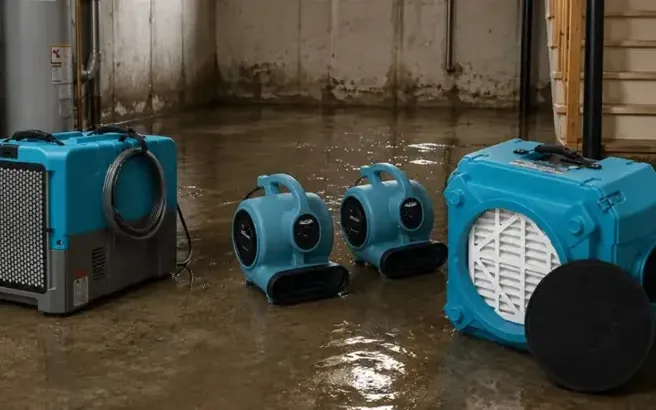
Structural drying is the stage after extraction that removes the water soaked into framing, subfloor, drywall and concrete. It is measured, not guessed: the drying team sets goals from a dry reference material in the same home, places air movers and dehumidifiers to the evaporation load of each room and reads the same points every day until they come down.
How structural drying and dehumidification is handled, step by step
Map
Readings set the dry reference and goals.
Set up
Air movers and dehumidifiers placed to the load.
Log
Psychrometric and material readings daily.
Verify
Equipment leaves when goals are met.
Classes of loss
- Class 1: little water, low-porosity materials
- Class 2: a whole room, carpet and wall bottoms wet
- Class 3: water from above, walls soaked high
- Class 4: bound water in dense materials like hardwood, plaster and concrete
The class sets how many air movers and how much dehumidification a room needs.
Wet framing or a soaked slab? Drying teams set up 24/7.
Ask what the readings showDry valley air and wet winters
Summer air in the valley is dry, which helps evaporation, but closed rooms still trap moisture and need dehumidifiers. In a wet winter spell, indoor humidity climbs and LGR units do most of the work. Concrete slabs, common under homes built from the 1970s on, are Class 4 and can take longer; desiccant units help there. The Energy Saver program explains household humidity and ventilation basics.
Why readings decide
Equipment stays until materials read within 2 to 4 points of the dry reference, and the daily psychrometric log shows temperature, humidity and grains per pound improving. That log is also what the adjuster reads, and the California Department of Insurance explains how to ask about a claim. The drying time estimator gives a rough window.
First steps when structural drying and dehumidification shows up
Keep the heat moderate
A normal room temperature helps the dehumidifiers work.
Leave equipment running
Switching air movers off sets the drying back.
Keep doors as set
The crew sets doors and containment for airflow.
Report any new damp spot
Tell the crew about new stains or smells.
What does structural drying and dehumidification cost in Ramona, CA?
Structural drying typically runs $1,200 to $6,000 for most homes, set by the class of loss, how many rooms need equipment and how many days the air movers and dehumidifiers run. Concrete and hardwood take the most days.
One room, Class 1 or 2
- Air movers
- LGR dehumidifier
- Daily readings
Several rooms or Class 3
- Containment
- More equipment
- Cavity drying
Class 4, slab or hardwood
- Desiccant units
- Longer run
- Extended logs
What moves the number
Ranges are typical, not a quote. Water category, square footage, material class and how fast drying started move the total most. Run the water damage cost calculator for a closer range.
Structural drying and dehumidification across the Santa Maria Valley and the backcountry
Ramona Water Damage Restoration covers ZIP 92065 across the Santa Maria Valley, from Main Street and the junction of State Route 67 and State Route 78 out to San Diego Country Estates in the San Vicente Valley, Mt. Woodson, the Ballena Valley and the ranch roads off Dye Road and Warnock Road.
Nearby coverage reaches Alpine, Valley Center, Julian, Santa Ysabel, Wynola, Four Corners, Fernbrook and Poway.
Related water damage services nearby
Structural Drying and Dehumidification questions, answered
Why can't the air movers come out when the carpet feels dry?
Framing, subfloor and wall cavities hold water after the surface feels dry. Pulling equipment early leaves moisture behind, so readings decide when it comes out.
What is a dry reference?
A reading taken from the same material in an unaffected part of the home. Wet materials are dried until they read within 2 to 4 points of it.
What does an LGR dehumidifier do?
A low grain refrigerant dehumidifier pulls more water out of the air than a household unit, even as the air gets drier, so drying keeps moving toward the goal.
How long does structural drying take?
Usually three to five days for a contained loss. Slabs, hardwood, plaster and losses that sat for days take longer.
Is the drying equipment noisy?
Air movers and dehumidifiers make steady fan noise. The crew places them for airflow, and they run around the clock until the readings say dry.
Damp framing stays damp until it is measured dry
Get moisture mapping and drying equipment working toward a verified dry reading.
(888) 450-9281Set up the drying equipment