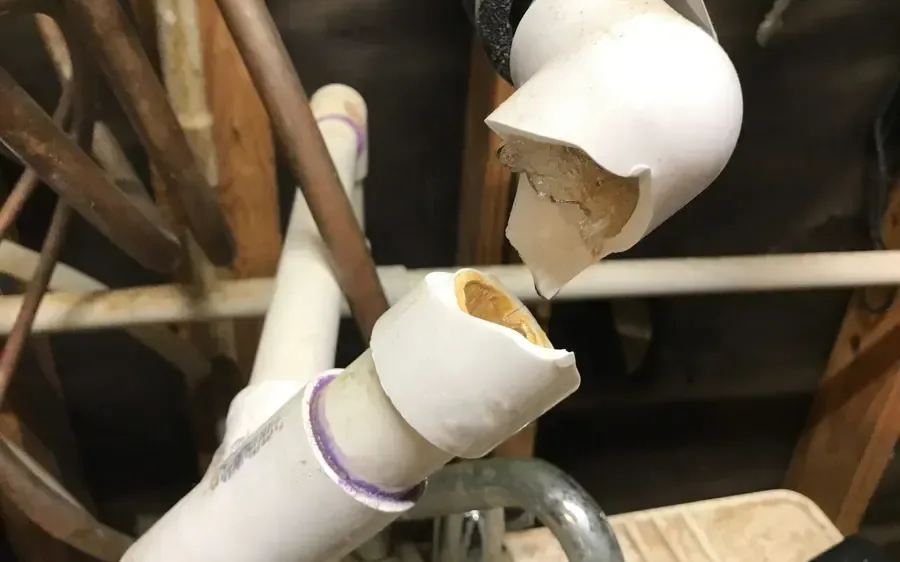
Julian is a mountain community where snow arrives every year. A pipe that freezes in an occupied home is a nuisance, but a pipe that splits in an empty home can run unseen for a long time.
Key takeaways
- This mountain town sits at 4,226 feet and gets snow every year, mostly in February and March.
- Mean daily lows are 38.8 degrees F in January and February, with record lows of 14 degrees F in January and 15 degrees F in February and December.
- At the 2020 census, 24.0% of the 988 housing units in town were vacant, and developments such as Hoskings Ranch are predominantly vacation homes.
- Ice expands and splits a pipe, but the water only runs once the pipe thaws, which is why damage often shows when someone returns.
- General UC Master Gardeners guidance says even a small crack can lose more than 250 gallons a day. That is general guidance, not a local measurement.
The mountain cold, in numbers
Julian sits at an elevation of 4,226 feet and has more extreme temperatures and more precipitation than much of Southern California. It receives snow every year, mostly in February and March.
NOAA 1991 to 2020 normals show about 24.48 inches of precipitation a year and 6.4 inches of snow. The mean daily minimum is 38.8 degrees F in January and February and 38.1 degrees F in December.
Snow falls on about 1.8 days a year on average, with 1.9 inches in February and 3.0 inches in March. Summer is the driest season, with some monsoonal storms from the southeast, so winter is when pipes face the cold.
Averages stay above freezing, but individual nights go well below, as the record lows show.
- Mean daily low in January and February: 38.8 degrees F
- Mean daily low in December: 38.1 degrees F
- Record low in January: 14 degrees F
- Record lows in February and December: 15 degrees F
How freezing turns into water damage
Water expands as it freezes. That pressure can crack a pipe wall or split a joint, but the ice often plugs the crack at first.
Pipes along outside walls, in garages, in unheated utility rooms and outdoors at hose bibs are the first to freeze.
Thawing can be quick on a warm afternoon, so a split that held through a freezing night can start flowing by midday.
The leak starts when the ice melts. A homeowner who is present may hear it, while a home with nobody inside has nobody to notice.
General UC Master Gardeners guidance says even a small crack in a pipe can lose more than 250 gallons a day. That is a general figure, not a local measurement, but it shows how a small split can add up over a few days away.
Why empty homes take the worst of it
At the 2020 census, Julian had 988 housing units, and 24.0% of them were vacant. Developments such as Hoskings Ranch expanded the town into the early 2010s and are predominantly vacation homes.
A vacation home may sit empty through a cold snap. Nobody drains pipes, checks the floors or reads the water meter.
That does not mean vacation homes are neglected. It means the usual early warning, a person in the house, is missing.
Signs after returning to a cold-weather home
A returning owner may find a puddle, a stain or nothing visible at all. A pipe can split in a wall and soak the cavity without a drop reaching the floor.
The first move is to shut off the water at the main and the power to wet areas.
A split inside a wall can send water down into the floor below. In a home with an upper floor, that can include the ceiling under a bathroom.
- Water stains on ceilings or walls that were dry before
- The sound of running water in a quiet house
- Low water pressure or a tap that only sputters
- A wet floor near an outside wall, the water heater or a pipe run
- Warped baseboards or lifting floor planks
What extraction and drying involve
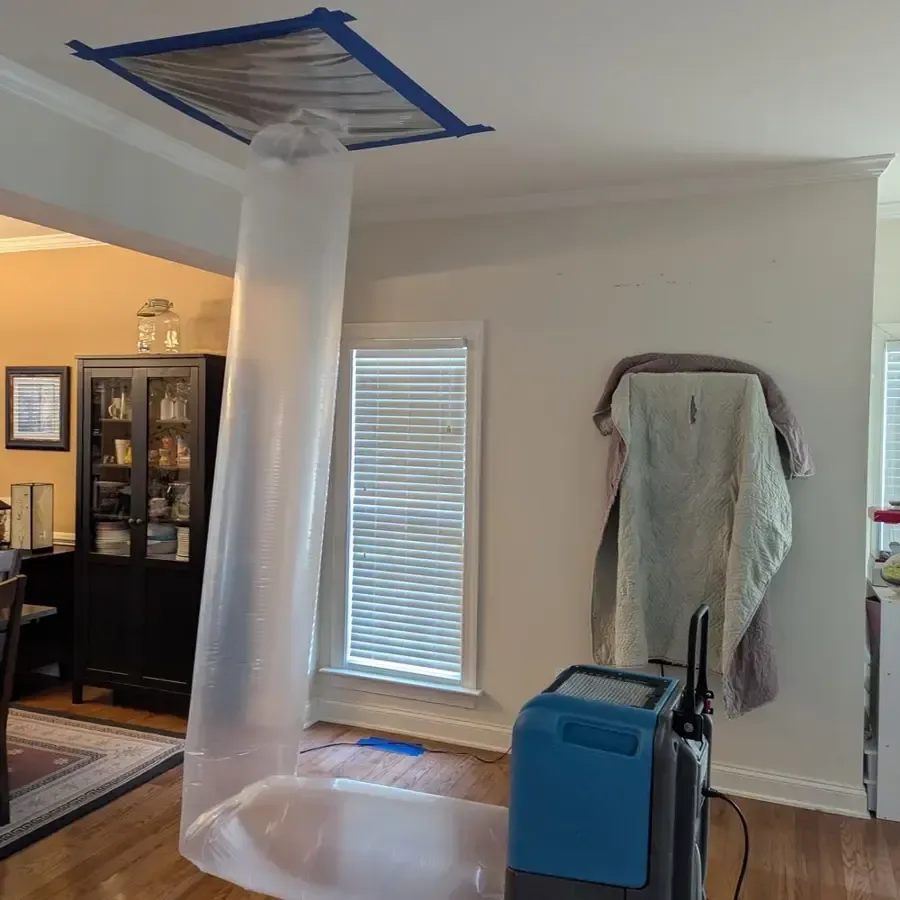
The work starts with the water on the floor and ends with readings that show the structure is dry.
Extraction
Water is pulled from floors, and carpet and pad that stayed wet for a long time are usually removed. Water extraction comes first because standing water keeps wicking into walls.
Speed matters because mold can begin on wet materials within 24 to 48 hours, and standing water keeps wicking into the walls while it sits.
Frozen pipe jobs often involve more than one split, because the same cold night reaches several pipes at once.
Opening and drying walls
Where the split ran inside a wall, drywall is opened so the cavity can dry. Insulation that took in water is removed.
Dehumidifiers and air movers run until readings reach the dry reference. A returning owner can read more about frozen pipe water damage locally.
What a long leak soaks
A split that runs for days reaches well past the spot where the pipe opened. The list below is where wetness usually turns up.
- Subfloor and flooring near the split
- Drywall at the bottom of the wall
- Insulation inside the cavity
- Cabinets and furniture against the wall
- The ceiling below, if the split is above
Closing up a cold-weather home
A few habits lower the odds of a split pipe in a home that will sit empty. They do not remove the risk, but they shrink it.
Draining matters because water left in a pipe is what freezes. A shutoff alone stops new water but leaves what is already inside.
After a loss, photos of the split pipe, the wet areas and the removed materials belong in the file, along with the plumber's invoice and the drying readings. Coverage for a frozen pipe varies by policy, and more on local conditions is under local water damage restoration.
- Shut off the main water supply before leaving for a stretch of cold weather
- Open taps briefly to drain the pipes, then close them
- Leave the heat on at a low setting
- Open cabinet doors under sinks on outside walls
- Ask someone to check the house during a cold snap
Questions
How cold does it get here?
Mean daily lows are 38.8 degrees F in January and February, with record lows of 14 degrees F in January and 15 degrees F in February and December.
Does a frozen pipe leak while it is frozen?
Often not. Ice can plug the split, and the water runs once the pipe thaws.
How much water can a small crack lose?
General UC Master Gardeners guidance says more than 250 gallons a day. It is a general figure and not a local measurement.
How common are vacant homes in town?
At the 2020 census, 24.0% of the 988 housing units were vacant.
What should be done first after finding a split pipe?
Shut off the water at the main, turn off power to wet areas, photograph the damage and arrange extraction.
Is a frozen pipe covered by insurance?
Coverage varies by policy, and some policies set conditions for vacant homes, so the wording is worth reading before a loss.