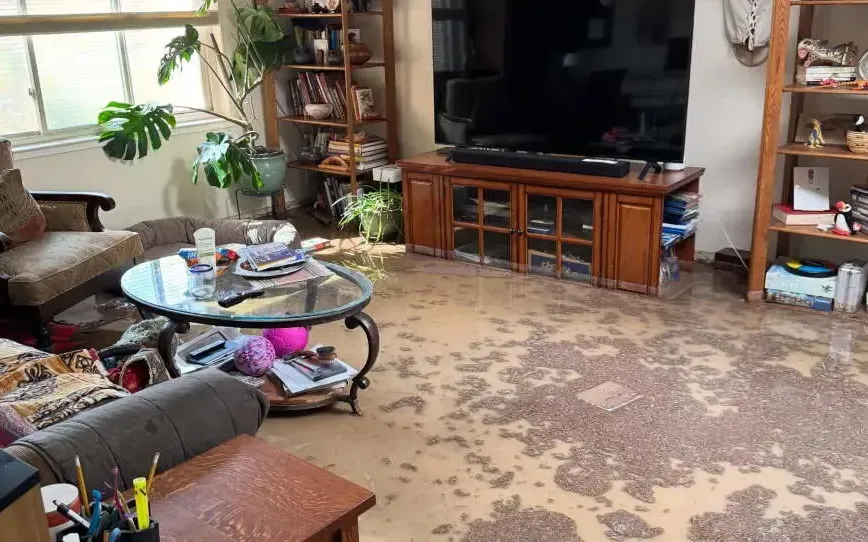
Rain that stays outside is a weather story. Rain that crosses a threshold and soaks a floor is a cleanup job with its own rules. Ramona has a long record of wet and dry years, and the swings in that record are a good reason not to relax after a quiet winter.
Key takeaways
- Runoff that enters a house carries soil, silt and bacteria, so it is treated as contaminated water instead of clean water.
- The order of work is standing water and mud out first, porous materials removed next, then structural drying measured with moisture readings.
- The airport rain record that starts in 1974 runs from 4.55 inches in the driest rain year to 35.80 inches in the wettest, so one quiet winter predicts little.
- Dated photos, a list of removed materials and the drying log make a storm claim easier to document.
- Wet materials left in place can grow mold within 24 to 48 hours, which is the main reason extraction starts quickly.
What the Ramona rain record shows
Rainfall here runs higher than in San Diego, and the record shows how far it can swing.
At Ramona Airport, the record that starts in 1974 shows rain years from 4.55 inches (July 2001 to June 2002) to 35.80 inches (July 1977 to June 1978). Those two years are the extremes of one record.
A single month or a single day can matter more to a house than a whole year. The wettest month was January 1993, with 14.15 inches, and the most rain in 24 hours was 5.33 inches, on January 10, 1978.
None of these numbers predicts the next storm. They do show why a home that stayed dry for years can still take water when a heavy day arrives.
- Driest rain year in the record: 4.55 inches, July 2001 to June 2002
- Wettest rain year: 35.80 inches, July 1977 to June 1978
- Wettest month: January 1993, with 14.15 inches
- Heaviest 24 hours: 5.33 inches on January 10, 1978
Why runoff is not the same as clean water
Water that comes in from a yard, a driveway or a hillside has crossed soil and everything lying on it. By the time it reaches a floor, it carries silt, organic matter and bacteria.
That makes storm runoff a different job from a leaking supply pipe. Water from a pipe starts clean, and runoff never does.
Creeks and channels move the same kind of water at a larger scale. Santa Maria Creek begins near Ramona and flows north through the Ramona Grasslands and Bandy Canyon, where it joins Santa Ysabel Creek.
Together the two form the San Dieguito River.
A creek name only shows where storm water travels. It says nothing about any one house, and a house far from any channel can still take water through a door, a garage or a low wall.
The order of work inside the house
Crews follow a set order, so effort is never spent on materials that will be removed later.
Each step has a reason. Extraction limits how far water wicks, removal takes out what cannot be cleaned, and cleaning prepares the structure for drying.
Water and mud come out first
Portable pumps and extraction wands pull standing water off hard floors and out of carpet. Truck-mounted units take over when the volume is larger.
Mud and silt are shoveled or vacuumed up while they are still soft. Silt that dries onto a floor is harder to remove and keeps holding moisture.
Porous materials are removed, not saved
Anything that soaked up runoff and cannot be cleaned all the way through usually goes. Trying to save it leaves contamination behind.
- Carpet and pad that sat in the water
- Insulation inside wet wall cavities
- Drywall that wicked water up from the floor
- Cardboard boxes and soft goods that were stored at floor level
Cleaning comes before drying
Framing, concrete and other hard surfaces that stay are cleaned and treated before drying equipment is set. Drying a dirty surface only locks the dirt in.
Drying, and the readings that show it is finished
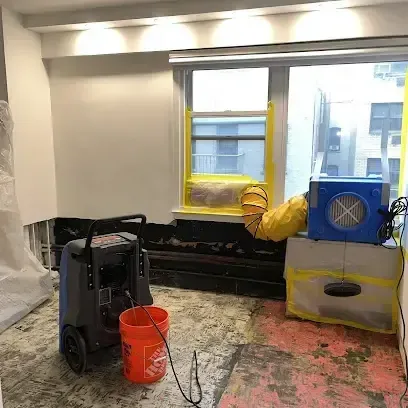
Once the house is clean, air movers and dehumidifiers pull moisture out of framing, subfloor and what is left of the walls. Moisture meters are read at the start and again on later visits.
Drying ends when readings fall to within 2 to 4 points of a dry reference taken from an unaffected part of the same house. A wall that feels dry can still read wet.
Moisture trapped in framing or behind baseboards is what lets mold start, which is why drying is measured instead of judged by touch.
Equipment moves as the wet zone shrinks, and the final readings are logged before rebuilding begins. A drying time estimator gives a rough range, though the readings make the real call.
- Starting readings set the baseline for every material
- Air movers and dehumidifiers run together, since moving air alone only shifts moisture around
- Readings are repeated until they match the dry reference
Safe steps while water is still in the house
Safety comes before saving belongings. Water, mud and electricity are a bad mix.
If runoff is still entering, sandbags or towels at a door buy time, but they do not replace extraction. Once water is inside, the priority is getting people and belongings to dry ground.
- Stay out of rooms where water reaches outlets, and cut power to the area at the panel only if the panel can be reached from a dry spot
- Keep children and pets away from muddy water
- Lift electronics, papers and small furniture off wet floors
- Photograph the water level, the damage and the point of entry before anything is moved
- Skip household vacuums for standing water, because they are not built for it
Records worth keeping for a claim
Policies often treat flood or surface water differently from a sudden pipe failure, so the cause of the loss should be described carefully and in plain words.
Mud-stained rooms often look worse than they are, and photographs taken before cleanup show the real extent.
Dated photos, a list of removed materials and the moisture log are the records most often asked for. They also show what was wet, how deep and for how long.
A storm flood cleanup crew can begin water extraction while the weather is still bad. Nothing here promises coverage, since the policy wording and the insurer decide that.
- Photos before, during and after cleanup
- A short note of when the water came in and where
- Receipts for emergency purchases
- The drying log with every reading and date
Questions
Is storm runoff in a house treated as contaminated water?
Yes. Runoff picks up soil, organic matter and bacteria on the way in, so it is handled as contaminated water. Porous materials it touched are usually removed.
Can wet carpet be saved after runoff?
Carpet and pad that sat in runoff are normally removed. A clean water leak gives carpet a better chance, but runoff does not.
How much rain has fallen in a single day here?
In the airport record that starts in 1974, the most in 24 hours was 5.33 inches, on January 10, 1978.
How long does drying take after a storm?
It depends on what got wet and how deep the water went. Moisture readings decide when drying ends, not the calendar.
Does a house need to sit near a creek to take storm water?
No. Water can enter through doors, garages and low walls, so a house away from any channel can still need extraction.
What happens to drywall touched by runoff?
Drywall that stayed wet or took in muddy water is cut out, usually a little above the waterline, so the wall cavity can be cleaned and dried.