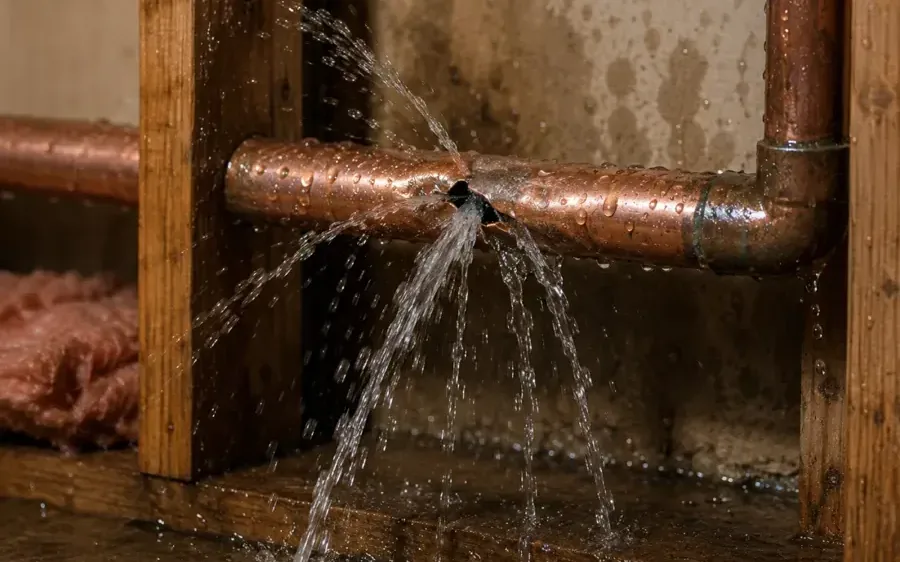
A pressurized pipe does not leak politely. It moves a startling amount of water in a short time, which is why shutting the water off matters more than almost any other step.
Key takeaways
- In May 2015, a 12-inch water district main near McNally and Carney roads burst, opened a three-foot sinkhole and lost an estimated 50,000 gallons over the hour it took to shut off the water and begin repairs.
- That main belonged to the water district and says nothing about pipes inside homes. The lesson is how much water a pressurized pipe can move.
- In a house, the first step is the main shutoff, found before an emergency instead of during one.
- Water from a split pipe runs through wall cavities, ceilings and floors, so extraction and opening of wet cavities follow the shutoff.
- Photos, moisture readings and the plumber's invoice make up the claim file.
The May 2015 break near McNally and Carney roads
In May 2015, a 12-inch main belonging to the Valley Center Municipal Water District burst near McNally and Carney roads. The district learned of the break around 2 a.m.
The pressure opened a three-foot sinkhole. An estimated 50,000 gallons of water were lost over the hour it took crews to shut off the water and begin repairs.
District officials said the pipe that broke had been installed in the 1960s.
The district is a public agency governed by an elected five-member board. It provides water service to more than 30,000 people in Valley Center and portions of Escondido and unincorporated areas of San Diego County.
- Pipe: a 12-inch district main
- Location: near McNally and Carney roads
- Result: a three-foot sinkhole
- Loss: an estimated 50,000 gallons
- Pipe age: installed in the 1960s
What the break shows, and what it does not
That main was the district's own pipe in the ground. It says nothing about the plumbing inside any house, and it should not be read as a claim about how old or how worn household pipes are.
What it does show is scale. Water under pressure keeps flowing until someone closes a valve, and the break above sent out an estimated 50,000 gallons in about an hour.
A split pipe in a house works on a smaller scale, but the principle is the same. The damage grows for as long as the supply stays open.
The 2015 break involved a 12-inch main, and a household pipe is far smaller. A smaller pipe at house pressure still delivers water steadily until the valve is closed.
Shutting off the water at home
Every household should know where the main shutoff valve is before a burst happens. Searching for it while water pours down a wall wastes the most valuable moments.
Writing down the valve location and showing everyone in the household is a small step with a large payoff. A tag on the valve helps a guest or a sitter find it.
If the valve will not close, a plumber can help. Individual fixture shutoffs can also stop a smaller leak.
Closing the main stops new water but leaves what is already in the pipes, which drains out through the break. Opening a low faucet drains the system and relieves pressure.
- Find the main shutoff valve and test that it turns
- Know where individual fixture shutoffs sit, such as under sinks and behind toilets
- Turn the main off first, then open a low faucet to drain what is left in the pipes
- Switch off power to wet areas if water reaches outlets or ceiling fixtures
Common causes of a burst pipe at home
Not every burst pipe has a dramatic cause. Most come from ordinary wear, a failed part or cold weather, and the damage pattern is the same once the pipe opens.
- A pipe that froze and split, with the leak starting at the thaw
- Corrosion or wear at a joint
- A failed fitting or connector hose
- Excess water pressure that stresses old joints
- Damage from a nail, screw or digging near a pipe
Where the water goes inside a house
Water from a split pipe takes the easiest path, and that path often runs through places nobody can see.
Walls and ceilings
A burst pipe inside a wall fills the cavity and runs down to the floor plate. In a ceiling, the water pools on drywall, which sags and then drops.
Insulation soaks up the water and holds it against the materials around it.
Floors and cabinets
Water reaches flooring through the base of the wall and spreads. Cabinet bases built from particle board swell, and carpet and pad act like sponges.
Hardwood flooring cups and buckles when wet, while tile may stay in place with the wall base opened.
- Wall cavity: the wet section is opened so the framing can dry
- Ceiling: sagging drywall is cut out and wet insulation is removed
- Floor: standing water is extracted, then the subfloor is dried
- Cabinets: toe kicks are removed so the base can dry
Extraction and drying after a burst pipe
Extraction pulls standing water from the floors. The crew then maps moisture in walls, ceilings and floors to learn how far the water traveled.
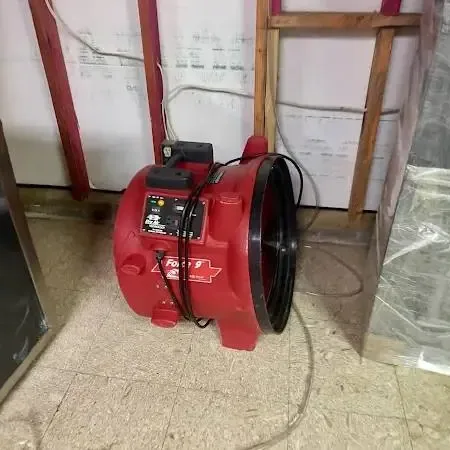
Wet drywall and insulation that cannot dry are removed. The remaining framing and subfloor are dried with air movers and dehumidifiers, and readings decide when drying is complete.
Drywall that stayed wet for a short time can sometimes be dried in place through small openings. A long leak usually needs removal, and readings, not appearance, make the call.
Plumbing repair and water cleanup run alongside each other. Burst pipe water damage and water extraction cover those two parts of the job.
What to keep for a claim
Photos of the burst pipe, the wet areas and every removed material belong in the file, along with the plumber's invoice, the drying log and dated readings.
Coverage for a burst pipe can differ from coverage for a slow leak, so the cause matters. Local detail is under Valley Center water damage restoration.
- Dated photos of the break and each wet room
- A list of removed materials
- The plumber's invoice
- Drying logs and final readings
Questions
How much water did the 2015 Valley Center main break lose?
An estimated 50,000 gallons were lost over the hour it took crews to shut off the water and begin repairs.
Does the 2015 break mean home pipes here are old?
No. The broken pipe was a district main installed in the 1960s. It says nothing about the pipes inside houses.
Where is the main shutoff valve in a house?
Locations vary. It is often near the water meter, on an exterior wall or in a garage, but every house is different, and finding it ahead of time is the point.
Can a wall be dried instead of opened after a burst pipe?
Sometimes. Readings show how wet the cavity is. A small, quick leak may dry through small openings, while a long leak usually needs the wall opened.
Should power be turned off after a burst pipe?
If water reaches outlets, switches or ceiling fixtures, yes, from a dry spot. An electrician checks the circuits before they are used again.
What is the first thing to do when a pipe bursts?
Close the main shutoff valve, switch off power to wet areas, photograph the damage and arrange extraction.