Structural Drying and Dehumidification in Valley Center, CA
Air movers, dehumidifiers and moisture readings dry the walls, subfloor and framing that hold water after the visible puddles are gone, and the readings prove the structure is dry before any repair starts.
(888) 450-9281Call about wet walls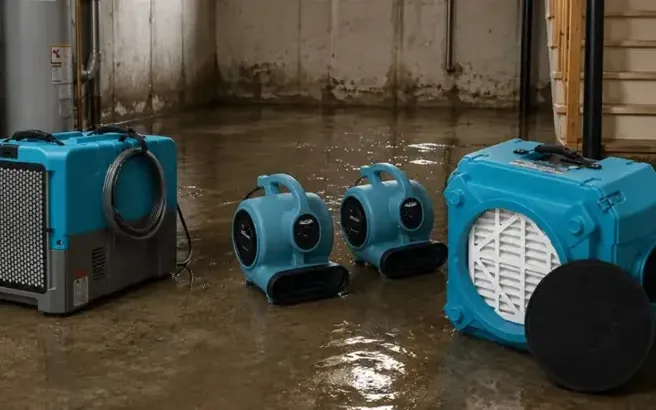
After water is extracted, most of the moisture is still inside the structure. Studs, subfloor, concrete and drywall hold water that cannot be seen, and it only leaves when air is moved and humidity is pulled out of the room. Structural drying is the part of the job that is measured, not guessed. Drywall, studs, subfloor and concrete each release water at their own pace, so the plan tracks every material on its own and the schedule follows the numbers rather than a set number of days.
How structural drying and dehumidification is handled, step by step
Map it
Meters show where the water is.
Place gear
Equipment fits the room.
Track it
Readings steer each visit.
Release it
Equipment leaves when dry.
How the equipment works together
- Air movers blow across wet surfaces to lift moisture
- Dehumidifiers pull that moisture out of the air
- Mats and tubes dry floors and wall cavities
- Meters track progress at every visit
The setup changes as the readings change, and equipment is moved or taken away once an area is dry.
Moisture left inside walls and subfloor can swell wood and invite growth, so drying should start once the water is removed.
Set up dryersWhy readings matter
A room can feel dry while the studs behind the drywall are still wet. The crew compares wet materials with an unaffected reference, and the job ends only when they match, so repairs are not built over trapped moisture.
What comes before and after
Drying follows water extraction, and it is the step that makes rebuilding safe. The Valley Center hub shows the other services the team provides when the water has a different cause.
First steps when structural drying and dehumidification shows up
Map the moisture
Meters and a thermal camera mark the wet materials.
Place the equipment
Air movers and dehumidifiers are set to match the room.
Read each visit
Moisture is checked and the setup is adjusted.
Confirm dry
Readings match the reference before equipment leaves.
What does structural drying and dehumidification cost in Valley Center, CA?
Drying one room at Class 1 or 2 usually costs $1,200 to $2,500. Several rooms or Class 3 conditions run $2,500 to $4,500, and Class 4 jobs involving slabs or hardwood can reach $6,000 or more.
One room, Class 1 or 2
- Equipment placed
- Daily readings
- Dry check
Several rooms or Class 3
- More equipment
- Wall cavities dried
- Longer runs
Class 4, slab or hardwood
- Drying mats
- Specialty tools
- Extended readings
What moves the number
Ranges are typical, not a quote. Water category, square footage, material class and how fast drying started move the total most. Run the water damage cost calculator for a closer range.
Structural drying and dehumidification across Valley Center and nearby communities
Structural drying covers ZIP 92082, from the newer homes in Park Circle to rural properties along McNally Road and Carney Road. The 2020 census counted 3,327 housing units, and nearly every one has framing and subfloor that can hold water out of sight.
The same service nearby: structural drying and dehumidification in Ramona, Julian, Alpine.
Water damage restoration in Valley Center › · every community covered
Related water damage services nearby
Structural Drying and Dehumidification questions, answered
How do you know when a structure is dry?
Moisture readings from wet materials are compared with an unaffected reference of the same material, and drying ends when the numbers match.
Why are dehumidifiers needed along with fans?
Fans lift moisture from surfaces, but only dehumidifiers remove it from the air. Without them the water just moves from the wall to the room.
Can walls be dried without opening them?
Sometimes, through small holes or by lifting baseboards, but saturated drywall and insulation are usually removed so the cavity can dry.
Is the equipment noisy and does it use much power?
It runs continuously and can be loud, but the setup is kept as small as the readings allow and removed as soon as areas dry.
Does insurance pay for drying equipment?
Many policies include the drying as part of covered water damage, and the logged readings help show why the equipment was needed.
Dry the structure before repairs
Tell the crew what got wet and the equipment plan follows from there.
(888) 450-9281Start the drying